Starling runs on your organization’s sovereign intelligence, so it reasons from your business instead of generic patterns.
Starling starts by provisioning a Notion workspace, where it writes your Constitutional Memories — the fifteen fundamentals every business needs to codify. Cancel and the repository remains yours. The First Fifteen give any advanced AI model the ability to extrapolate additional memory, so you stay because Starling works better for your team, not lock-in.
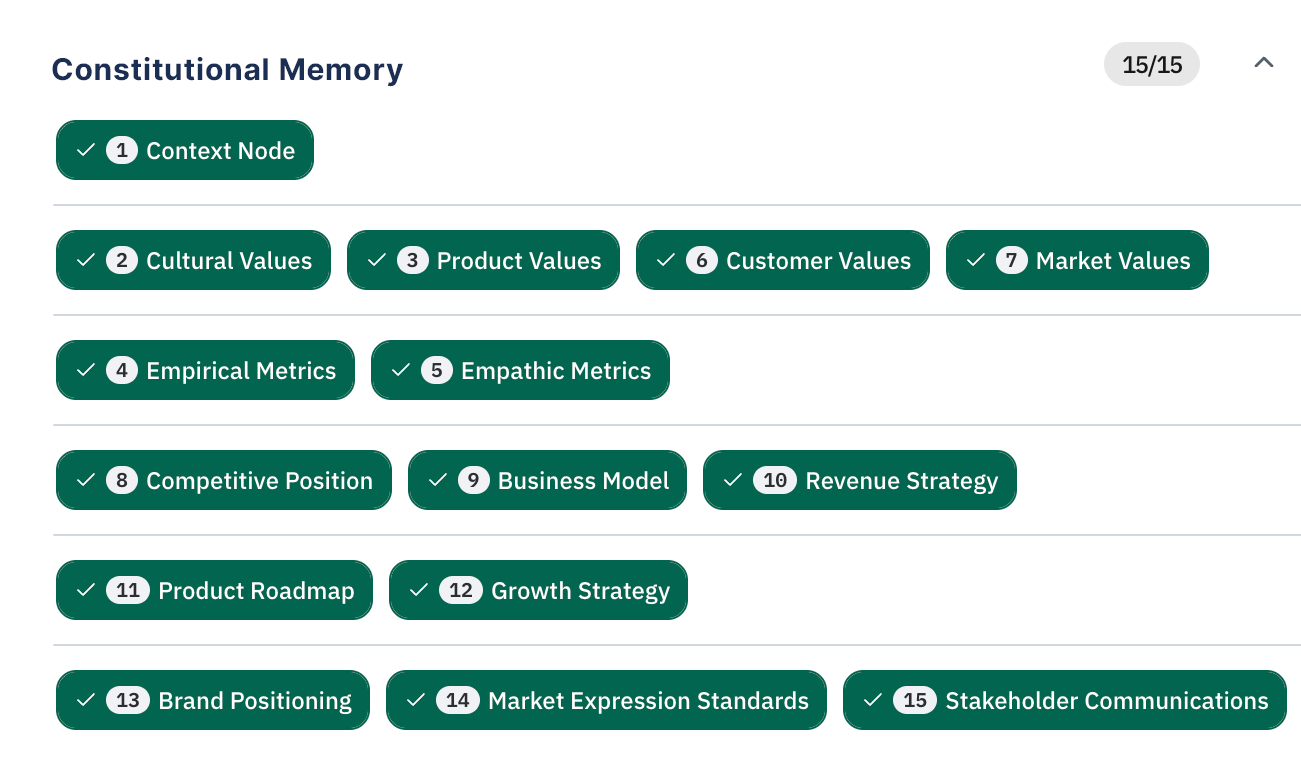
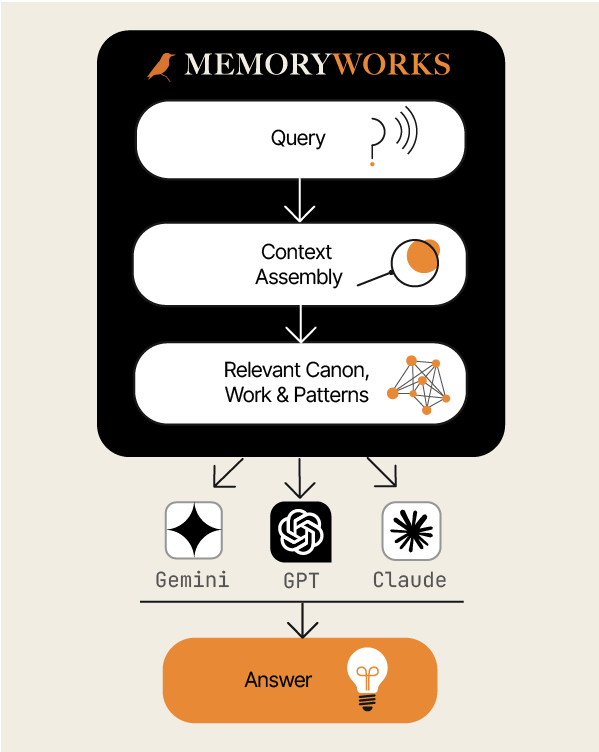
After establishing your Constitutional Memory, Smart OS activates and Starling becomes a model-agnostic AI chief of staff. It assembles context for session-based AI, helping you draft, decide, and plan with governed memory. Ask it anything about your business, and it keeps that context current as the work moves.
With your foundation in place, Starling builds out your extended canon and architects your active work, so every project and campaign inherits the latest context. As work completes, Starling extracts the patterns, and your repository becomes a compounding asset.
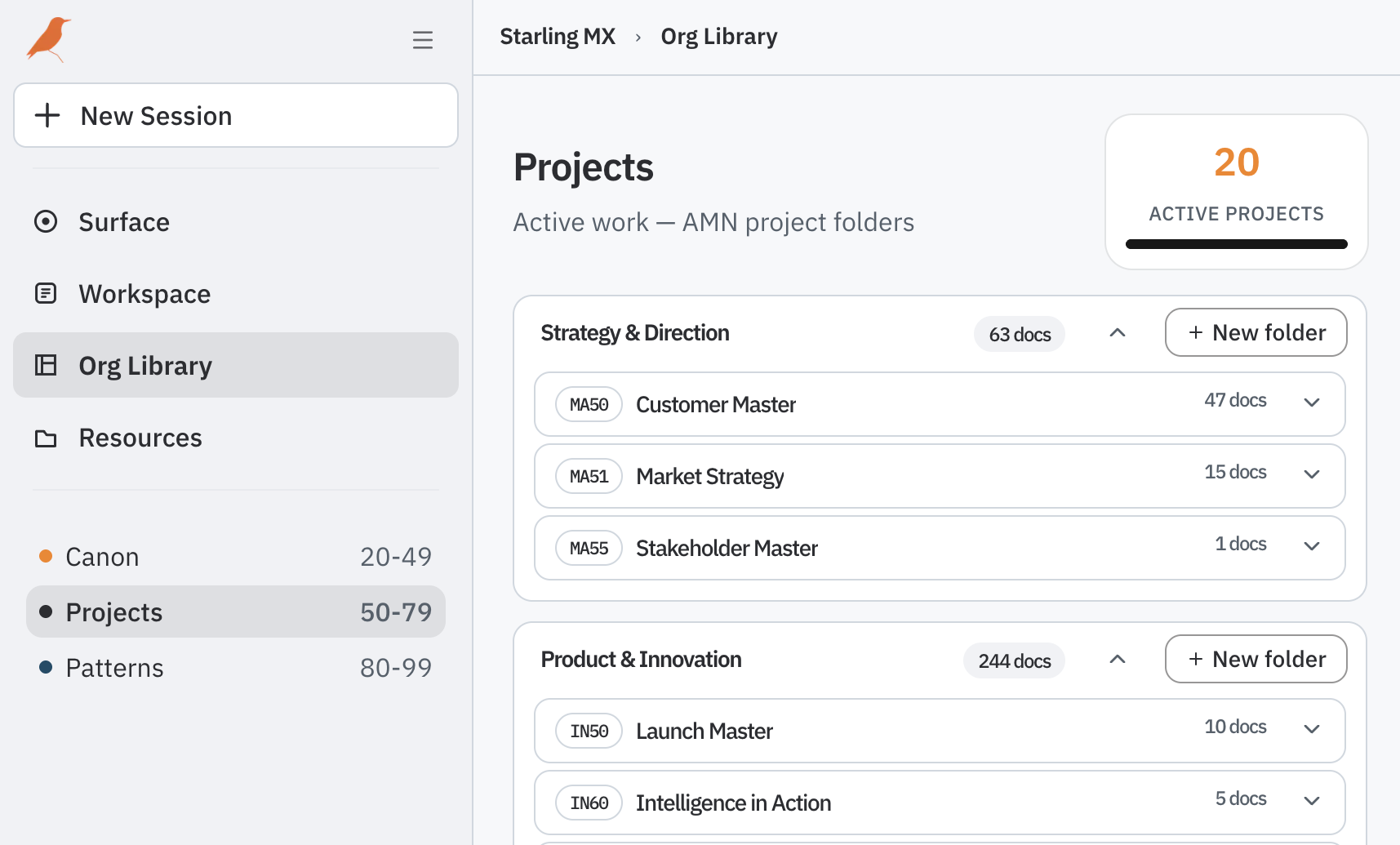
Your Org Library is your memory repository — where all work originates. It stores lossless Markdown artifacts that minimize token usage. This means everyday strategic queries are covered by your seat cost under normal use.
Two Workspace operations convert your memory from/to the lossy documents that drive heavy token usage: Excavation parses uploaded context, and Delivery turns out the finished documents that leave the building.
Both live in a separate repository, Resources — uploads coming in, work going out. You spend on translation between lossless memory and lossy documents. Your memory stays light and governed.
Starling works with the best of every model: Claude for work, GPT for voice, and Gemini for deep analysis.
They draw from the same pool, each on its own meter. Costs are transparent in your settings.
Build canon, convert documents, run strategy and queries.
Meters by tokens.
Talk to your brain, hands-free, for quick answers.
Meters by the minute.
A second-model pass when you want one.
Meters per run.
Starling starts with a single seat — the Owner, who builds your Constitutional Memory. Once you define your canon, you can invite your team.
Every business needs a dataset for AI and somebody to administer it. Starling provides the standards, across four types of memory: System, Persistent, Active, and Learned.
System memories are what every organization runs on. Persistent memories rarely change. Active memories are the daily work. Learned memories are institutional wisdom.
A leading AI lab had to pull its newest frontier models to comply with a government directive. Access only returned three weeks later.
The models weren’t the problem. The dependency was. When your workflow lives inside the AI, their compliance decision becomes your outage.
Starling holds your memory in a repository you own and reads it with whichever model is available — so no one provider stops your work. Governed memory produces better intelligence than AI memory: it stays current, it doesn’t drift, and every model reasons from the same truth.
Starling MX is early software. Onboarding works end to end and your repository is real and permanent from day one — but you’ll be among the first organizations through the door, and you’ll hit rough edges. In exchange you get direct access to the people building it, and your feedback shapes what ships next.
Complete onboarding and your Constitutional Memory is yours to keep, in a Notion workspace you own. Cancel any time and it stays yours.